
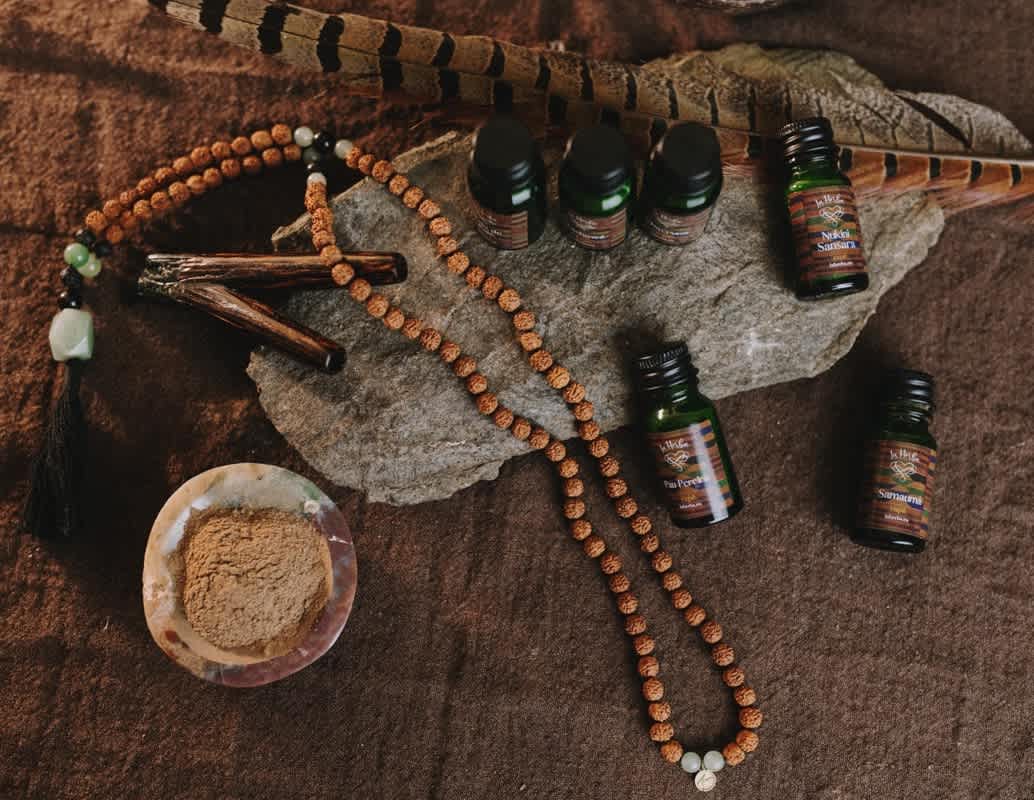
What Is Rapé (Hapé)? Origins Tradition
Rapé (you'll hear it as ha-PAY, sometimes written ha-peh) is a finely milled Amazonian snuff. The spelling drifts depending on who first wrote it down — Hapé, Rapeh, Hapeh all point to the same thing — but underneath the variation sits a specific preparation: ground ceremonial tobacco, the ash of a sacred tree, or bark, and, in most blends, a handful of other plants chosen by the maker. The powder is worked until it falls like talc.
Rapé reaches the nose through one of two carved pipes. A Kuripe is the short, V-shaped pipe a person uses on themselves; a Tepi is the longer pipe one person uses to serve another. The difference matters more than it first looks, and it has its own section below.
Where Rapé comes from
The roots of Rapé run back to terra preta — the "black earth" the western Amazonian peoples built by clearing forest, burning wood to ash, and folding those minerals back into the soil. The same hands that learned to read ash for the garden learned to read it for medicine. While younger men worked the earth, the Pajés (the shamanic elders) tested different tree ashes and plants and slowly worked out which combinations did what. Rapé sits at exactly that crossroads of agricultural and ceremonial knowledge.
Tobacco is the thread running through all of it. The ethnobotanist Johannes Wilbert described tobacco as the principal source of snuff across South America, and its ceremonial use long predates European contact. Among the Shipibo, healers traditionally sing over the leaf before it becomes medicine — the song is considered part of the preparation, not ornament around it. This is the tradition's own logic: the plant is approached as an ally, and the maker's state of mind is treated as an ingredient.
Oral Wisdom: The Shawandawa Lineage
In many Amazonian cultures, the deep wisdom surrounding sacred plants and medicines is not recorded in books; it is preserved and passed down orally through generations, kept alive by the community elders. A beautiful reflection of this living tradition comes from Wawacuru Curushiña (whose name translates to "Enchanted Macaw"), a respected elder and oral wisdom-keeper of the Shawandawa tribe.
In the traditional Shawandawa worldview, Rapé is approached as a holistic healing tool rather than a casual preparation. As Wawacuru describes it:
“Rapé is good for headaches, body pain, and increasing vigor. It lifts your mood, imparts inspiration, and can remove sorrows and sadness. Rapé increases your strength, elevates your mood, and supports your spiritual connection.”
This profound connection to the medicine is rooted in an ongoing, generation-spanning dialogue with nature. The elders of the tribe traditionally practice experimenting with different tree ashes, systematically discovering the diverse medicinal properties inherent in each species. Because of this careful, prayerful approach, every unique blend of Rapé is created with a distinct purpose, a specific prayer, and a focused intention.
The application itself follows a precise ritual structure. Whether the powder is taken individually using a Kuripe (the V-shaped self-application pipe) or served to another with a Tepi (the longer pipe used in shared settings), the act is sealed with the spoken word “Haux”—an ancient term used to affirm the healing intent, carry the prayer, and express deep gratitude.
How the Huni Kuin speak about Rapé
The Huni Kuin — "the true people," a Pano-speaking nation of the Brazilian and Peruvian Amazon, also known as the Kaxinawá — are among the peoples most closely tied to Rapé in the living plant tradition. Their knowledge isn't written; it's carried orally, and the elders and chiefs are its keepers. Ask after Rapé in a Huni Kuin village and you're as likely to be answered with a story or a song as with a recipe.
In their practice Rapé sits alongside ceremonial song and their work with Nixi Pae (the Huni Kuin name for Ayahuasca). Elders traditionally describe it as a way to clear panema — the heaviness that settles on a person — and to steady the mind and lift the spirits before chanting and ceremony. It's spoken of as something that sharpens attention and brings a person back to themselves, rather than as anything visionary. To explore how this energetic clearing manifests physically and mentally, see our detailed guide on the 7 Foundational Pillars of Rapé Effects.
The making carries the same weight as the using. Among the Huni Kuin the maker's intention is treated as part of the medicine: each blend is prepared with a specific purpose and a prayer, which is why no two are considered quite the same. Their elders also hold the old practice of working with different tree ashes — testing bark after bark over generations to learn the distinct character each one brings.
Who makes Rapé, and why intention runs through it
In Amazonian tribes Rapé isn't something just anyone prepares. Traditionally the work belongs to a Pajé, a Pajé's apprentice, or a member the tribe trusts — and the preparation is expected to carry a purpose rather than being made on autopilot. That's not folklore dressing. It's why two Rapés with an identical plant list, made by different hands, are considered different medicines.
The same emphasis carries into how Rapé is shared. In tradition the moment between the person serving and the person receiving is treated as an act of trust, and when a Tepi is passed around a circle it's understood as an exchange between everyone involved, not just a delivery of powder. You don't have to take the spiritual reading literally to see the practical point: this is a tradition that takes who, how and why as seriously as what.
What's inside Rapé
Three components, broadly.
First, the tobacco. Authentic Rapé is built on ceremonial Amazonian tobacco — often called Mapacho — and specifically heirloom strains such as Tabaco Sábia or Organic Mói (Nicotiana rustica or Nicotiana tabacum), grown from saved seed rather than bought in. Second, the ash. A sacred tree bark is burned to a pale alkaline ash; Tsunu (Platycyamus regnellii) is the classic, but it's only one of at least fifteen trees used this way. Third, the helper plants — Caneleiro, Murici leaves, Cumaru beans, Pixuri seeds, Parica yopo seeds, Jurema, Mariri and others, dried and shaved in by makers who want a particular character.
By traditional Amazonian standards, a blend isn't really Rapé unless tobacco is the primary ingredient. There's one well-known exception: the Apurinã prepare Awiry, a green snuff made entirely from a wild non-tobacco plant, with no ash at all. It's its own lineage, and it's deliberately not classed as Rapé.
How Rapé is made
Good Rapé takes weeks, sometimes months, and the work starts long before anything is ground.
The tobacco leaves are rolled into tight "logs" and left to ferment until the centre darkens and sweetens, then unfurled and sun-dried into a leathery sheet. The ash is its own craft: bark is burned low and slow in clay pots until it turns pale grey — hot enough to release the alkaline carbonates that give Rapé its bite, but not so hot that the minerals cook off. Helper herbs are dried and shaved separately.
Only then does the pounding begin. Everything goes through mortar and mesh, again and again, until the powder is talc-fine. Coarse, gritty Rapé is the clearest sign of a rushed batch — a well-made one is almost weightless between the fingers. This is also why who made a Rapé matters as much as the recipe: the same plants in two sets of hands produce two noticeably different snuffs.
The sacred trees and their ashes
The ash isn't filler — it's half the identity of a blend. The Amazon holds at least fifteen trees prized for Rapé ash, among them Tsunu, Paricá, Murici, Mulateiro, Imburana or Mulungu. Each has a sandy, textured bark that burns down to a fine, talc-like ash.
Tribes have their favourites. The Kuntanawa lean toward Mulateiro; the Yawanawá favour Tsunu. Some blends are nothing more than tobacco and a single ash, which tends to feel strong and direct. Others layer in dried leaves and bark from specialist plants, each chosen for a specific traditional role — which is how one tribe ends up with dozens of distinct Rapés rather than a single house style.
Tribal blends, and how they differ
If you remember only 3 blends, make it these.
Yawanawá Tsunu pairs hand-grown tobacco with light Tsunu ash. The Yawanawá regard it as their medicina central— the everyday foundation blend, gentle and grounding.
Yawanawá Paricá blends tobacco with Paricá bark ash (Anadenanthera peregrina) and Paxtu seeds (Iriartea deltoidea). It's the sharper, more activating member of the family — traditionally the night-hunt and all-night-chant blend.
Huni Kuin Murici mixes tobacco with fragrant Murici ash (Byrsonima crassifolia). Softer and aromatic, traditionally blown at dawn.
For a first purchase, three blends have earned a reputation as kind starting points: Tsunu for its gentle, grounded character; Cacau for its warm, roasted-cacao aroma; and Canela-de-Velho for its light, clean profile. If the aroma side appeals to you, Cacau is the natural bridge — and it sits well alongside a Ceremonial Cacao practice. Browse the full range in our Rapé collection.
What's in it, chemically
For the curious, a classic Tsunu-tobacco Rapé has been analysed properly, and the numbers settle a few myths.
The dominant alkaloid is nicotine, from the Mapacho tobacco. Low-temperature curing also leaves trace β-carbolines(harmane and norharmane). And the Tsunu ash supplies mineral alkali — chiefly calcium and potassium carbonate — which raises the alkalinity of the powder.
A 2022 UFAC study put figures to it: across eight Yawanawá Tsunu samples, nicotine ran 8–11 mg/g and β-carbolines averaged about 0.5 mg/g, well below any visionary threshold. The same ash measured roughly 42% CaCO₃ and 13% K₂CO₃ — a lot of buffering capacity. This is the point worth stating plainly, and it's why the entheogen, not hallucinogen distinction matters: Rapé is not psychoactive in the visionary sense. The chemistry doesn't support it, and reputable makers don't claim it.
Rapé and Ayahuasca
You'll often see Rapé mentioned in the same breath as Ayahuasca (known in several tribes as uni). In many traditions the two sit close together — Rapé is used around uni and mariri (ceremonial song) gatherings as part of the wider ritual fabric, rather than as a substitute for anything. It's context worth knowing if you've come to Rapé through the broader world of Amazonian plant tradition.
Rapé and the chakra question
Search Rapé online and you'll quickly hit chakras — blends sorted by which "energy centre" they're said to open. It's worth being clear about where that idea comes from. The chakra system belongs to Indian yogic and tantric tradition; it isn't Amazonian. The Amazon has its own vocabulary — panema (the heaviness a person carries), the role of the Pajé, the distinct spirit attributed to each plant — and that's the language the tradition itself uses. Modern practitioners often lay the two frameworks over each other because they map loosely, which is fine as a personal lens, but it's a contemporary blend rather than something the tribes describe. We mention it only so you can tell the two apart when you read around.
Kuripe vs Tepi
These two pipes get lumped together, but they do different jobs.
A Kuripe is the small self-application pipe, bent into a V so one end reaches the nose and the other the mouth — made for a solo practice. A Tepi is the longer, straight pipe used to serve another person, which is why it belongs to shared and ceremonial settings rather than private ones — and why, in tradition, passing the Tepi carries that sense of exchange between people.
Materials are the thing to check before buying. You'll find both carved from bamboo and from bone, sometimes wrapped or beaded. Bamboo is lighter and the usual entry point; bone pieces are heavier, more durable and generally more finely finished. If you only ever practise alone, a Kuripe is all you need — the Tepi earns its place once there are two people in the room.
A note on breath
Different tribes name the breath rather than any measure. You'll hear of the Tartaruga (turtle — slow and soft), the Veado (deer — medium), and the Beija Flor (hummingbird — sharp and quick), with others such as Jiboia and Onça appearing tribe to tribe. It's a vocabulary for describing tradition, not a recipe — included here so the terms make sense if you come across them.
Frequently asked questions
Is Rapé the same as Hapé?
Yes. Rapé, Hapé, Rapeh and Hapeh are all spellings of the same Amazonian snuff. The variation comes from writing Indigenous and Portuguese pronunciation into English.
Is hapé the same as HAPE, the medical condition?
No. HAPE is high-altitude pulmonary edema. Rapé/hapé is an unrelated Amazonian plant preparation. The overlap is only in the letters.
Is Rapé a hallucinogen?
No. It's usually described as an entheogen — a plant with cultural and symbolic significance — not a hallucinogen. It isn't visionary, and the measured chemistry backs that up. Instead of visions, it provides psychological and grounding alignment. You can read a deeper breakdown of these advantages in our article on the 10 Potential Benefits of Hapé.
What is Rapé made of?
Ceremonial Amazonian tobacco (Mapacho, often heirloom Tabaco Mói), the ash of a sacred tree such as Tsunu, and, depending on the blend, helper plants like Murici, Cumaru or Pixuri.
Why so many spellings?
Because the word was carried orally and written down by many different people. None is "wrong" — they're regional and phonetic.
Is Rapé the same as Yopo?
No. Yopo is a separate Anadenanthera-based snuff with a different botanical basis and a different profile. Some Rapé blends use Paricá (Anadenanthera peregrina) ash, but that isn't the same thing as Yopo.
Is Rapé legal?
Legal status varies by country, so check your local rules. We supply Rapé as an ethnobotanical product, not for internal use (see below).
Does a bigger amount mean a stronger result?
A common misconception. In the tradition the character of a blend — its tobacco, its ash, the maker — counts for far more than quantity. The strongest tribal Rapés are the most carefully prepared, not the most heaped.
Quick glossary
- Mapacho — ceremonial Amazonian tobacco, the tobacco base of most Rapé.
- Tabaco Sábia — heirloom jungle tobacco strain grown specifically for Rapé.
- Tsunu — Platycyamus regnellii; sacred tree whose alkaline ash is widely used.
- Kuripe — V-shaped pipe for self-application.
- Tepi — long pipe used to serve Rapé to another person.
- Pajé — Amazonian shaman, healer or elder.
- Panema — energetic heaviness or stagnation, in tribal terms.
- Uni — Ayahuasca; a ceremonial brew of the western Amazon.
- Mariri — ceremonial chanting or song.
- Entheogen — a plant used in a symbolic, ceremonial sense rather than for visions.
- Haux! Haux! — a traditional word of affirmation, gratitude and good intention that closes the act
- Haux e muita alegria - Blessings and much joy
A note on how we offer Rapé
We sell Rapé, Kuripe, Tepi, Mapacho and related items as ethnobotanical products for collection, ritual and incense purposes — not for internal use. They are tobacco-based. Nothing on this page is medical advice or a usage instruction; the cultural and traditional material here describes Amazonian practice, it doesn't recommend it.
Haux e muita alegria!
Legal & Medical Disclaimer:
All information, cultural histories, and indigenous lineages presented in this article are for educational, historical, and ethnographic research purposes only. The products mentioned and offered on this website are raw botanical specimens, intended solely for collection, scientific study, and ritual incense use, and are strictly not for ingestion, inhalation, or any form of internal human consumption. These statements have not been evaluated by any medical regulatory authority. Rapé is a tobacco-based preparation containing naturally occurring nicotine; it is not intended to diagnose, treat, cure, or prevent any physical or mental health condition. The handling and use of these materials are entirely at the buyer's own risk and responsibility.
Embodiments of Master Saint Germain

In the 11th century BC, Saint Germain was embodied as the prophet Samuel. Saint Germain was embodied as Saint Joseph, the father of Jesus and the husband of Mary.
• In the late 3rd century, he ...
Kambo frog vaccine medicine
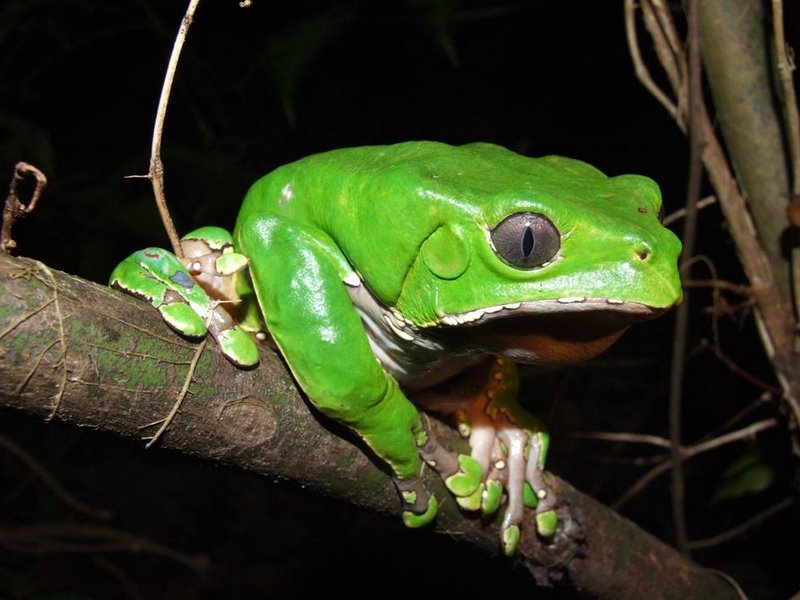
Kambô, also known as the “frog vaccine,” is the cutaneous secretion of the frog Philomedusa bicolor, native to the Amazon rainforest. Originally, the use of kambô is associated with the native conc...
10 Possible Benefits of Rapé
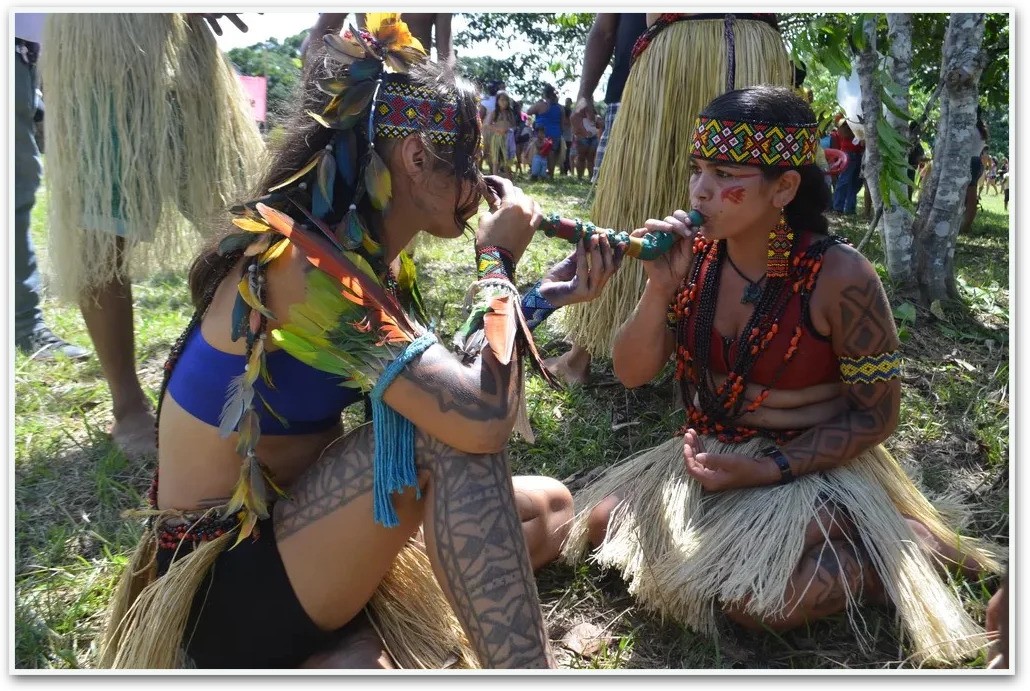
Rapé, a sacred botanical preparation rooted in indigenous traditions, is often used ceremonially as an incense or for nasal application. While it holds deep ethnographic and historical value, its u...
Ways to Blow Rapé
There are many ways to blow Rapé: Long and slow, quick and sharp, and everything in between. You will soon learn to judge what is most appropriate, depending on your particular style or the needs o...