
What Is Rapé (Hapé)? Sacred Amazonian Shamanic Snuff Guide
If you've found your way here, you've probably already seen Rapé spelled five different ways and wondered which one is "right." Rapé, Hapé, Hapeh, Rapeh, even Ruma — they all point to the same thing, and the spelling depends mostly on which tribe, language, or trader you're hearing it from. In English it's pronounced "ha-peh," with a soft stress on the second syllable. Not "rape," which trips up almost everyone the first time they read it.
Rapé is a fine, dry snuff made in the Amazon basin, traditionally blown into the nostrils through a small pipe. That's the short version. The longer version — where it comes from, what's actually in it, how the tribes prepare it, which blend suits a beginner, and why the tool you use matters as much as the powder — is what this guide is for.
We've worked with these medicines for years, sourcing directly from indigenous producers and small family workshops, and most of what circulates online about Rapé is either recycled from the same handful of blog posts or quietly invents things to sound mystical. This is the version we'd give a friend who asked us, "Okay, but what is this stuff, really?"
One note before we start. Throughout this article we describe Rapé the way the traditions that created it describe it. Where we mention effects, properties, or uses, we're reporting what indigenous practitioners and contemporary ceremonial communities say — not making claims of our own. All of our products are offered as ethnobotanical samples, not for internal use. The full disclaimer sits at the bottom, and it means what it says.
What Rapé actually is
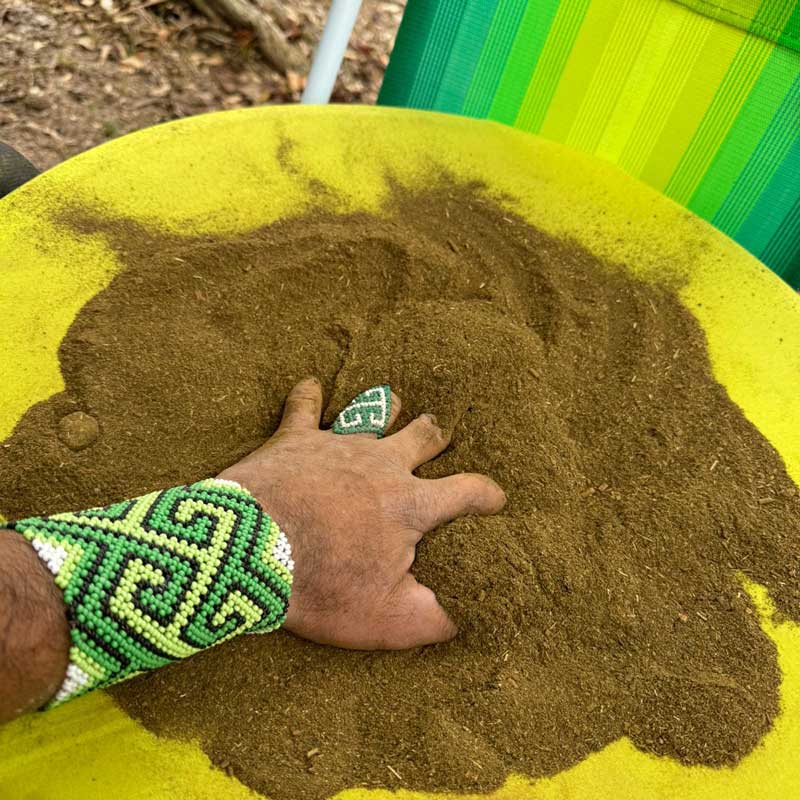
At its simplest, Rapé is a powder. A very fine one — when it's made well, it has the texture of talcum and almost no grit between your fingers.
The base of most blends is Mapacho, a strong Amazonian tobacco. This is where a lot of confusion starts, so it's worth being precise: the tobacco in traditional Rapé is usually Nicotiana rustica, not the Nicotiana tabacum in cigarettes. They're different plants. N. rustica is far more potent, grows shorter and hardier, and has been cultivated ceremonially across South America for a very long time — long before anyone rolled tobacco into a cigarette for pleasure. In our blends, the primary tobacco is Tabaco Sábia, a variety the producers we work with prize for its character and consistency.
Mixed into that tobacco base is ash. Not just any ash — it's made by burning the bark or branches of specific trees, each chosen by tradition for the qualities it's said to carry. Tsunu, Murici, Cumaru, Caneleiro: different woods, different character, and the choice of ash is a big part of what separates one blend from another. Some recipes add ground herbs, seeds, or leaves on top.
So when someone asks "what's in Rapé," the honest answer is: it depends entirely on who made it and which tradition they're working from. There is no single recipe. That variety is the whole point, and it's why two blends both labelled "Rapé" can feel completely different to the people who use them.
The fineness matters more than people expect. Good Rapé is sifted repeatedly until it reaches something close to 125 microns — fine enough to feel weightless, like talc. A coarse, gritty snuff usually signals a rushed or low-grade batch.
Not every Rapé even contains tobacco, by the way. The most famous exception is Apurinã Awiry, a vibrant green snuff the Apurinã make from a single wild jungle plant — no tobacco, no ash at all. Strictly speaking it's its own lineage rather than Rapé in the classic sense, but it tends to get grouped in because of how it's used.
A quick word on the name
You'll see Rapé, Hapé, Hapeh, Rapeh, and others. Here's the practical breakdown.
Rapé is the spelling that travelled through Portuguese-speaking Brazil — it traces back to the French râper, "to grate" or "to rasp," which is also where the European word for grated snuff comes from. So "Rapé" is really the colonial-era trade name.
Hapé / Hapeh is closer to how several indigenous groups actually say it, and many practitioners now prefer these spellings precisely because they sidestep the awkward English collision. Both are correct. We use Rapé and Hapé interchangeably, leaning on Hapé when we want to honour the indigenous pronunciation.
If you're searching for it, just know all the variants float around, and suppliers use them inconsistently.
Where Rapé comes from
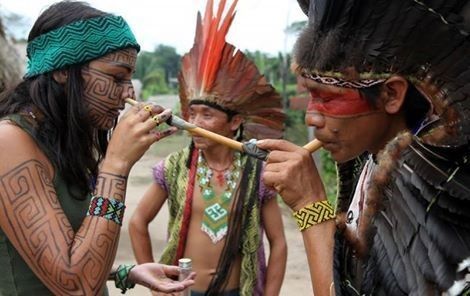
Rapé is woven into the ceremonial life of many peoples across the western Amazon — particularly in what is now Brazil, Peru, and Colombia. Tribes such as the Huni Kuin (Kaxinawá), Yawanawá, Nukini, Kuntanawa, Katukina, and Shipibo each have their own relationships with it, their own recipes, and their own protocols around who may prepare and serve it.
Snuff-taking in the Americas is genuinely ancient — used in the jungle for thousands of years before any European saw it. One of the earliest written traces comes from Columbus's second voyage, when the friar Ramón Pané recorded indigenous people using a powdered snuff in ritual around 1493.
Then there's the strange European chapter most people don't know about. In the mid-16th century, snuff crossed the Atlantic and became a luxury of the aristocracy. King Philip II had tobacco seeds brought from the Americas and planted near Toledo, and nasal snuff took off among the Spanish elite as a high-status indulgence. It spread to the French court too — the story goes that it was sent to the wife of Henry II of France in connection with her son's migraines. By the 18th and 19th centuries, Rapé had become a full-blown symbol of refinement: elaborate gold and silver snuff boxes set with precious stones were traded as diplomatic gifts between royal courts. Napoleon was famously rumoured to keep a personal supply with him, even on campaign.
By the 20th century, cigarettes had largely displaced snuff in Europe and the fashion faded. But in the Amazon, the tribes never stopped — their tradition ran on unbroken the entire time. Today Rapé is having a global renaissance, with Brazil as the main producer and tribes like the Huni Kuin, Yawanawá, and Nukini still crafting it by ancestral methods. Much of the Rapé reaching Europe comes directly from these Brazilian communities.
We dig into this history more fully in our History of Rapé article if you want the whole arc.
How Rapé is made
This is the part most articles skip, and it's the part that actually justifies the price and the reverence.
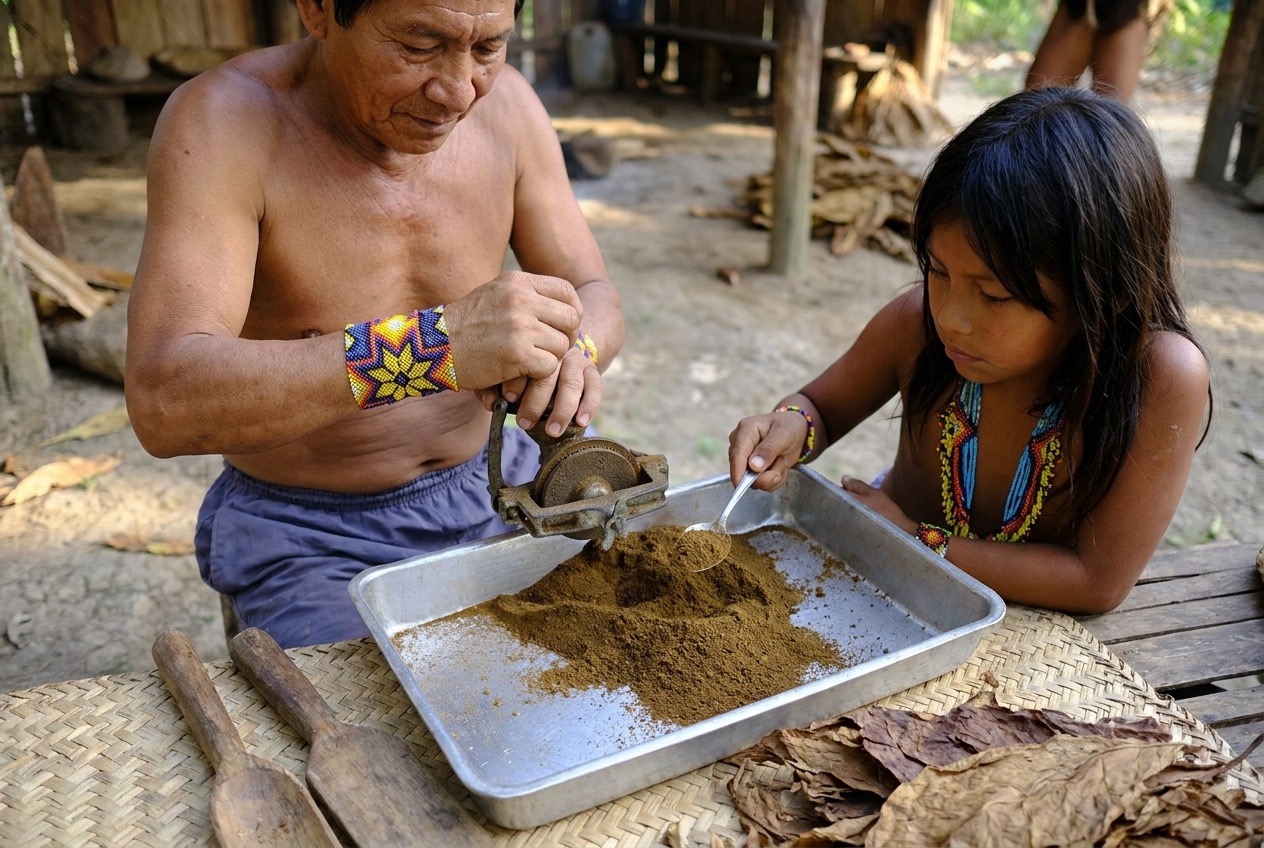
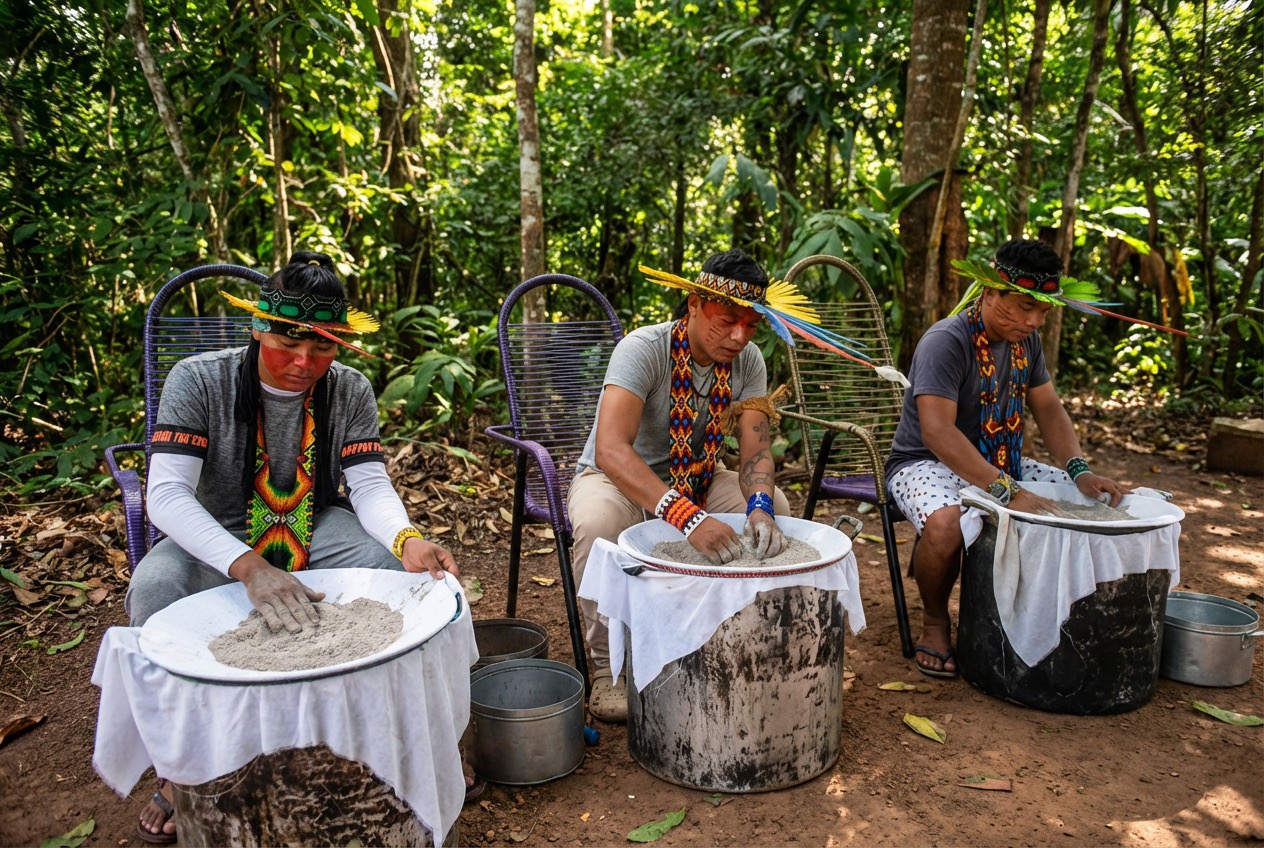
Making good Rapé is slow, physical work. In the traditional setting, the right to prepare it isn't open to everyone — it generally belongs to a Pajé (the Tupi word for a shaman or medicine-keeper), an apprentice, or a trusted elder of the community. The recipe and the technique are passed down, not improvised. Historically it's often the men or the Pajés who make it, though there are beautiful exceptions: the Força Feminina blends are crafted exclusively by the women of the Yawanawá.
The broad process looks something like this. The tobacco is cultivated, harvested, dried, and toasted. Separately, the chosen tree bark or wood is burned down to a clean, pale ash. Both are then ground — historically by hand, with a mortar and pestle, which is genuinely demanding when you're chasing that talc-fine texture. The tobacco and ash are combined in proportions the maker knows by feel and tradition, then the whole mixture is sifted. And sifted again. And again. Each pass through finer mesh pulls out grit and produces a lighter, more even powder.
A single good batch can take days. The multi-day, small-batch nature of it is exactly why authentic Rapé from a careful producer doesn't look or feel like the cheap stuff — and why suspiciously mass-produced "Rapé" is a red flag.
In the traditions, the preparation isn't only mechanical. Makers describe holding intention and prayer throughout — the medicine is understood to carry the state of mind it was made in. Whether or not that resonates with you, it tells you something practical: this is craft made with attention, by people for whom it isn't a commodity.
The types of Rapé: how the tradition groups them
Most Rapé falls loosely into families, and they map onto how the tradition itself talks about it. The lines aren't rigid — blend, setting, and intention shape everything — but the grouping genuinely helps when you're choosing. Read what follows as how practitioners describe each family, not as a promise of what it'll do for you. We cover this in much more depth in our dedicated guide to Rapé intentions and types; here's the orientation.
Grounding — the everyday family. Soft blends, often built on light Tsunu or Murici ash, reached for when practitioners want a settled, present, clearer head rather than anything dramatic. This is where most newcomers start. Blends like Cumaru, Jatobá, and Mulateiro live here.
Cleansing — stronger, more direct, often plain tobacco-and-ash. The tradition ties these to tirar a panema, "clearing the heaviness" (more on Panema below). Practitioners often describe an emotional reset afterwards. Think Caneleiro or Tsunu Yawanawá.
Ceremonial — the communal family, the Rapé of prayer, song, and gathering rather than a quiet morning alone. In the western Amazon these accompany uni (Ayahuasca) and mariri (ceremonial song). Blends like Aya Caapi Cipó and Veia de Pajé belong here.
Heart-opening — gentler and aromatic, most associated with the Cacau blend, where roasted cacao is worked into the mix. Warm and softening rather than activating, and a natural companion to a Ceremonial Cacao practice.
Protection and Warrior Energy sit at the more specialised, experienced end — denser hardwood-ash blends spoken of as an energetic boundary, or sharp high-tobacco blends the tribes traditionally reached for before a hunt or hard work. Dreamwork is the smallest family, tied to night practice and the threshold of sleep, with the tobacco-free Apurinã Awiry at its centre.
If you only remember one thing here: the name "Rapé" on a label tells you almost nothing. The family, the tobacco, and the ash tell you everything. You can browse all of them in our Rapé collection.
Tepi and Kuripe: the two ways it's served
You can't really talk about Rapé without the tools, because Rapé is always blown, never casually sniffed. Two instruments do the job, and the difference between them is one of the most common questions we get.
The Kuripe (self-application)
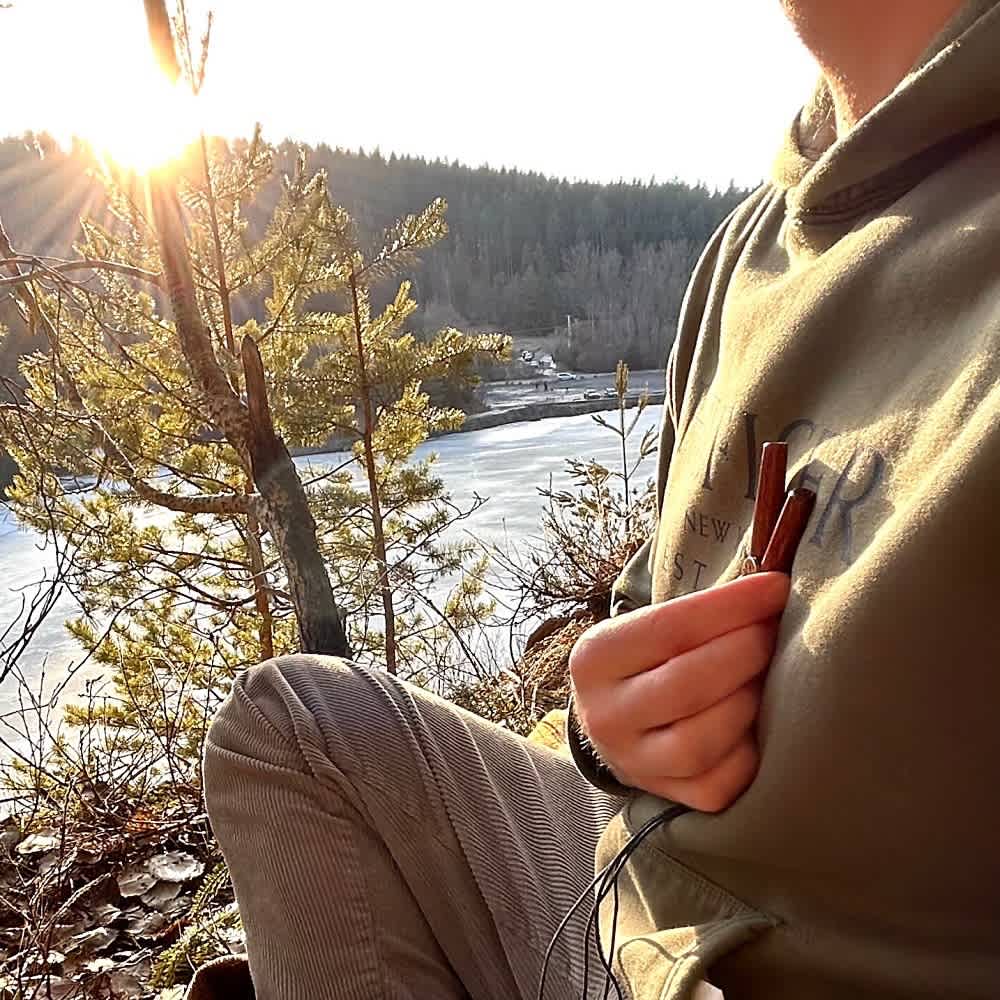
The Kuripe is the self-applicator: a short, V-shaped pipe. One end sits at your mouth, the other reaches a nostril, and you blow your own dose. The V-shape is the giveaway — it connects your own breath to your own nose.
Kuripe are traditionally made from bamboo, bone, or carved wood, and a good one is a small piece of craftsmanship. Bone has a particular feel and a long working life; bamboo is lighter and more affordable. If you're using Rapé on your own, this is the tool you want. Browse ours here.
The Tepi (one person serves another)
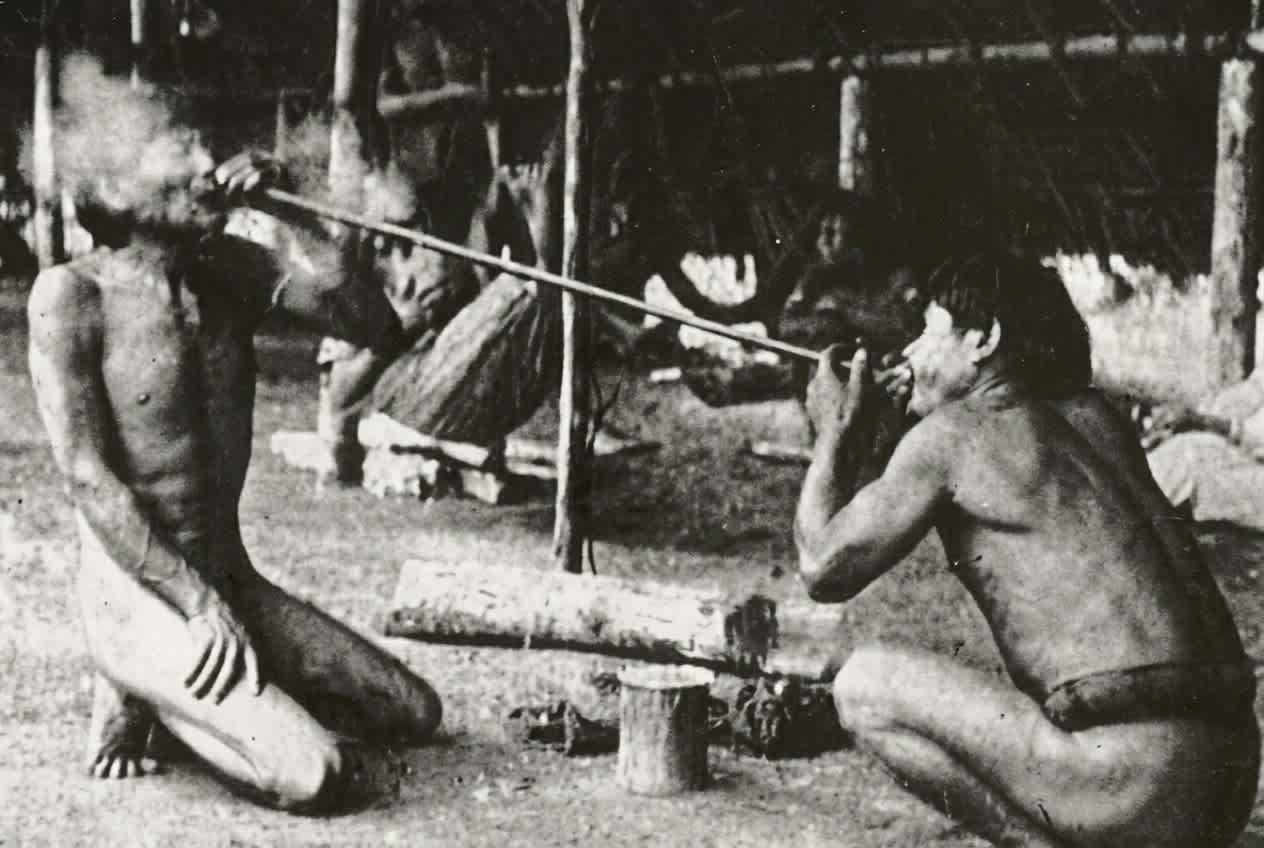
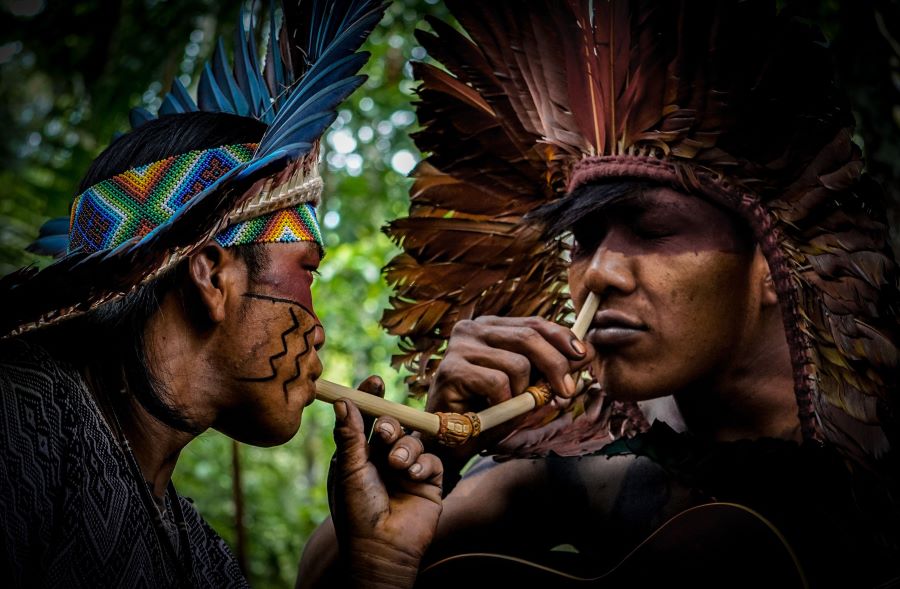
The Tepi is longer and straight — one person blows the Rapé into another person's nostril through it. This is the ceremonial, relational tool: one serves, the other receives, and in tradition the server's breath and intention are part of what's being given. The act of blowing for another is sometimes called the Soplada, and in ceremony it's treated as a moment of trust between two people. Find ours here.
Which should you start with?
Simple rule: using Rapé by yourself → Kuripe. Working with a partner or group → Tepi. Plenty of people start solo with a Kuripe and add a Tepi later, once they have someone to share the practice with.
Ways to blow Rapé
Once you're past the basics, how the Rapé is blown shapes the whole character of the moment, and the tradition has names for the styles.
The Beija Flor — "Hummingbird" — is a short, sharp blow: a quick, awakening hit. The Jiboiá — "Boa Constrictor," named for an animal the tribes deeply revere — is the opposite: long, slow, and gentle with an acceleration right at the end, suited to a more contemplative, meditative state. There's everything in between, and servers learn to read which suits the moment and the person in front of them. A small detail makers swear by: finishing a blow with a deliberate "click" of the tongue against the roof of the mouth, rather than letting it trail off, makes for a cleaner, more satisfying application.
We go deeper on this in Ways to Blow Rapé.
The symbolism of the nostrils
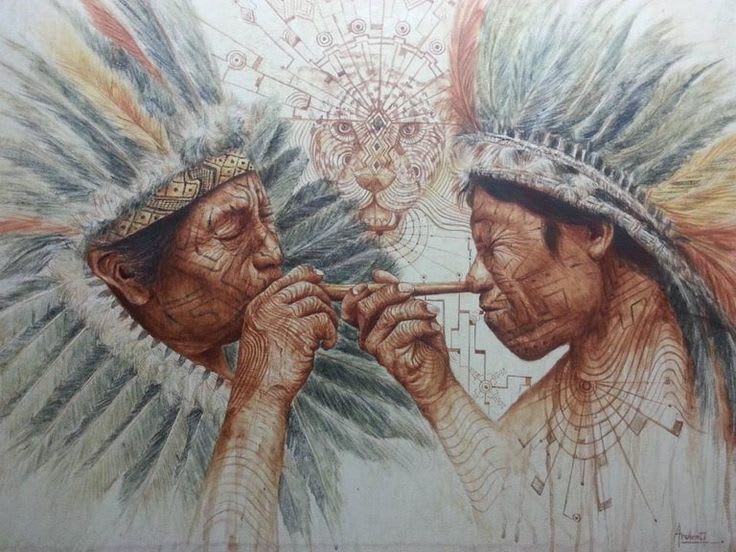
One detail that surprises newcomers: in several traditions, the two nostrils aren't interchangeable. The left is associated with death — a letting-go, a release of what no longer serves — and the right with rebirth, a renewal. Serving into one and then the other is, symbolically, a passage from one state to the next.
You don't need to subscribe to any of this to use Rapé, but it's part of the traditional framework, and it explains why practitioners are deliberate about the order rather than treating it as a quick sniff.
Rapé in the tradition: what practitioners describe
Here's where we need to be careful and honest, because this is exactly where most Rapé content slides into health claims it shouldn't make.
We're not going to tell you Rapé does anything to your body. What we can do is describe how the traditions understand it, and what contemporary ceremonial communities report — clearly framed as their perspective, not as fact.
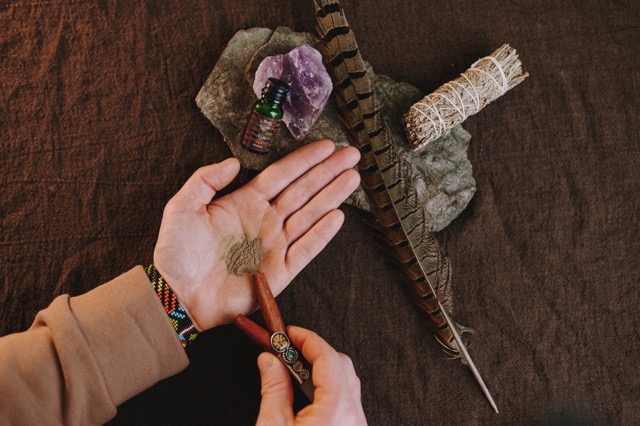
Within the traditions, Rapé is regarded as a sacred medicine and an entheogen — a term for plants used in a sacred, symbolic, consciousness-oriented context, as distinct from recreational substances. Importantly, it isn't psychoactive in the visionary sense; there are no hallucinations. Practitioners most often describe a sense of grounding and presence— being pulled out of mental chatter and back into the body and the breath — and many speak of focus and a clearing of mental fog.
A key concept here is Panema. In Amazonian shamanism, Panema names a state of spiritual stagnation — a heavy, stuck, unlucky energy that's understood to settle on a person. One of the central traditional reasons for using Rapé is to "clear Panema," lifting that heaviness and restoring vitality. The stronger cleansing blends are the ones most tied to this idea.
Across these communities, the consistent thread is intention. The tradition holds that the state of mind of both server and receiver shapes the experience — which is why ceremony, respect, and preparation matter so much within that worldview.
And the exclamation you'll hear: among Pano-speaking peoples like the Huni Kuin and Yawanawá, "Haux Haux"(roughly "howsh") is spoken at the start or end of a sitting to carry prayers and express gratitude to the spirits of the plants — something like "let it be affirmed."
A note on chakras and the "third eye"
You'll see a lot of Rapé sold with talk of opening chakras, activating the third eye, or "decalcifying" parts of the body. Two honest things.
First, the chakra system is not native to the Amazon — it comes from the spiritual traditions of India. When Western practitioners describe Rapé in chakra terms, they're interpreting an Amazonian medicine through a framework borrowed from a different culture entirely. That's not necessarily wrong — people are free to weave their own meaning — but no Amazonian tribe traditionally thought about Rapé this way, and anyone presenting chakra-talk as "ancient Amazonian wisdom" is blurring two very different traditions. (If you're curious how Westerners actually apply that lens, we explore it in Rapé and the Sacral Chakra.)
Second, claims about the medicine physically altering glands or organs aren't something we'll repeat or endorse. They're not part of the genuine indigenous framing, and they aren't supported by anything we'd stand behind.
We flag all this not to be killjoys, but because you deserve to know which parts of the online "Rapé lore" are traditional and which are modern Western additions.
Choosing your first Rapé
Since we actually sell this, here's the practical buyer's-eye view we'd give anyone starting out.
Start grounding, not intense. A soft, grounding blend is a far better first step than reaching for the strongest thing on the shelf. You can always work up; it's much harder to un-scare yourself if you start too strong.
Judge by texture. Good Rapé is fine and even, close to talc. Gritty or coarse usually means a rushed sift or a lower grade.
Look for transparency. Real, traceable Rapé comes from specific producers and traditions. A seller who can tell you which blend, which tribe or workshop, and roughly what's in it is a safer bet than one selling anonymous "Amazonian snuff."
Get the right tool. Solo practice → a Kuripe. Serving others → a Tepi.
A few honest practicalities
Rapé is legal, and it's traditional — but it's also potent, and it deserves respect rather than novelty-seeking. The communities that gave us Rapé surrounded it with protocol for good reason.
Stored well — airtight, dry, dark, cool — a quality blend keeps its aroma and character for several months. And while traditional blends are tobacco-based, remember there are exceptions like Awiry that contain none at all.
Finally: spelling won't help you judge quality. Whether a seller writes "Rapé," "Hapé," or "Hapeh," it's the producer, the tradition, and the texture that matter.
Bringing it together
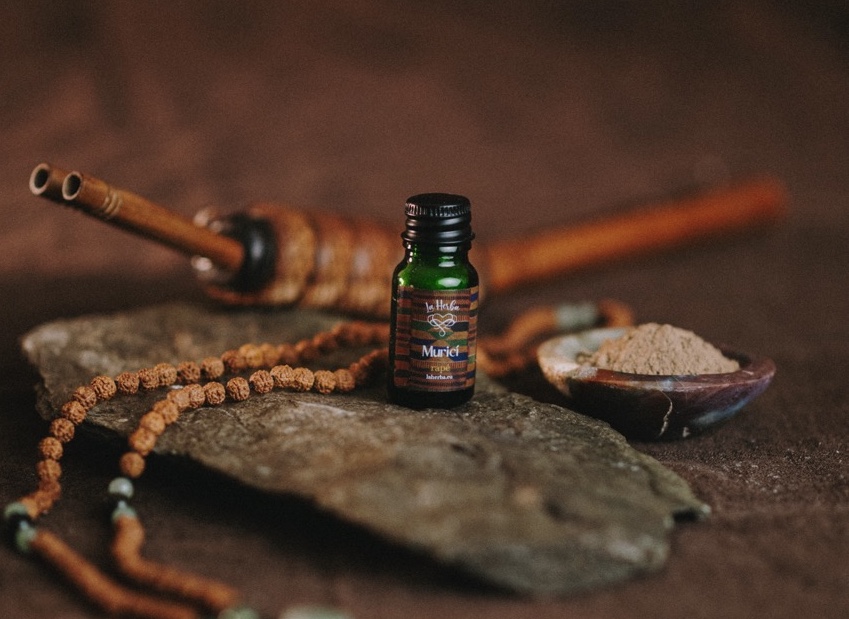
Strip away the marketing and Rapé is a remarkably specific, hand-crafted thing: a talc-fine snuff of toasted Amazonian tobacco and sacred-tree ash, prepared slowly by people who treat the making as seriously as the using, served through a small bone or bamboo tube in a moment of intention. Everything that makes it worth seeking out — the range of blends, the depth of tradition, the care of real producers — is also what makes it impossible to reduce to a single line.
If you're new to it: start simple. A grounding blend, a Kuripe to learn on, and no rush. The tradition has been unhurried about this for centuries — there's no reason to be otherwise now.
Frequently Asked Questions
How do you pronounce Rapé?
It's pronounced "ha-peh," with a soft stress on the second syllable — not like the English word it resembles. The spellings Hapé and Hapeh reflect this pronunciation more closely, which is partly why many practitioners prefer them.
Is Rapé legal?
Yes. Rapé is legal and is sold as an ethnobotanical sample for its ethnographic, cultural, and historical value — not for ingestion. As with anything, handling is the responsibility of the purchaser, and local rules can vary, so it's worth checking what applies where you are.
What is Rapé made of?
Most blends combine a strong Amazonian tobacco (Mapacho, usually Nicotiana rustica) with ash made from the bark or branches of specific trees such as Tsunu, Murici, or Cumaru. Some recipes add herbs, seeds, or leaves. A few varieties, like Apurinã Awiry, contain no tobacco and no ash at all.
What's the difference between a Tepi and a Kuripe?
A Kuripe is a short, V-shaped pipe for self-application — you blow your own dose. A Tepi is a longer, straight pipe through which one person serves another. Use a Kuripe for solo practice and a Tepi for working with a partner or in a group.
Which Rapé is best for beginners?
A soft, grounding blend rather than a strong cleansing or warrior blend. The tradition treats grounding blends as the everyday starting point, and it's far easier to work up gradually than to start too intense.
Does all Rapé contain tobacco?
No. While traditional blends are built on Mapacho tobacco, certain varieties are completely tobacco-free. The best-known is Apurinã Awiry, a green snuff the Apurinã make from a single wild plant, with no tobacco and no ash.
What does "Haux Haux" mean?
Among Pano-speaking peoples such as the Huni Kuin and Yawanawá, "Haux Haux" (roughly "howsh") is spoken at the start or end of a sitting to carry prayers and express gratitude to the spirits of the plants — something close to "let it be affirmed."
What is Panema?
In Amazonian shamanism, Panema describes a state of spiritual stagnation — a heavy, stuck energy understood to settle on a person. The tradition speaks of using Rapé to "clear Panema" and restore vitality, and the stronger cleansing blends are the ones most tied to this idea.
How long does Rapé stay fresh?
Stored airtight in a dry, dark, cool place, a quality blend keeps its aroma and character for several months.
More Q&A you can find in our blog article here.
Haux e muita alegria <3
DISCLAIMER - ETHNOBOTANICAL SAMPLE
This natural product is offered exclusively as an ethnobotanical sample for ethnographic, historical, cultural, educational, and research purposes. It is not intended for ingestion, inhalation, smoking, or any form of internal or medicinal use.Handling and use are entirely the responsibility of the purchaser. Further details can be found in our Disclaimer.
Ceremonial Cacao – The Elixir That Opens the Heart
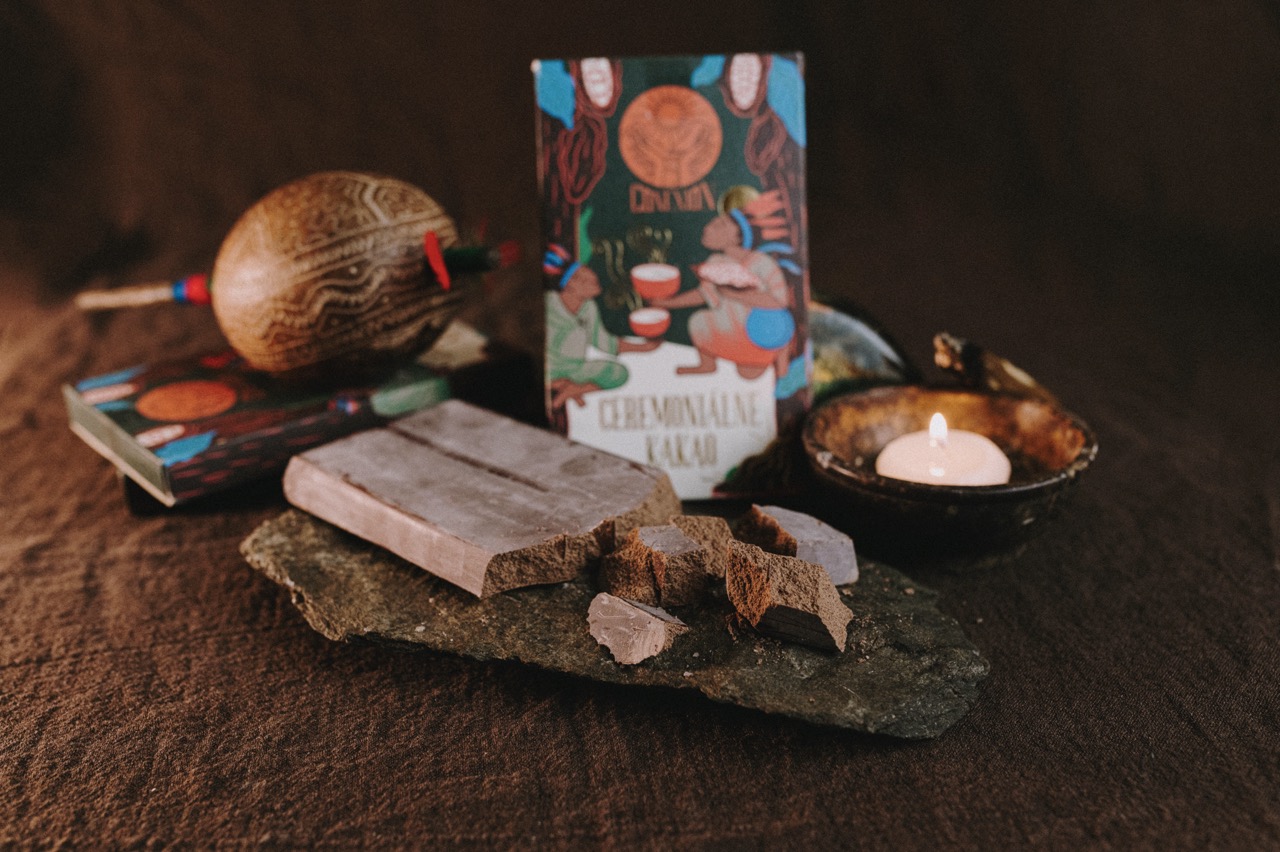
Ceremonial cacao is much more than a hot drink. It is a sacred gift from the Earth, used for centuries in spiritual practices and healing rituals by indigenous cultures of South and Central America...
Chaga Siberian, Chaga - the strongest natural antioxidant in the world
Content of the article
1. What is chaga? What does this miracle mushroom bring?
2. What is chaga used for?
3. For what problems is it appropriate to reach for chaga?
4. What spectrum of vitamins does...
Tepí - blowers, applicator for Rapé
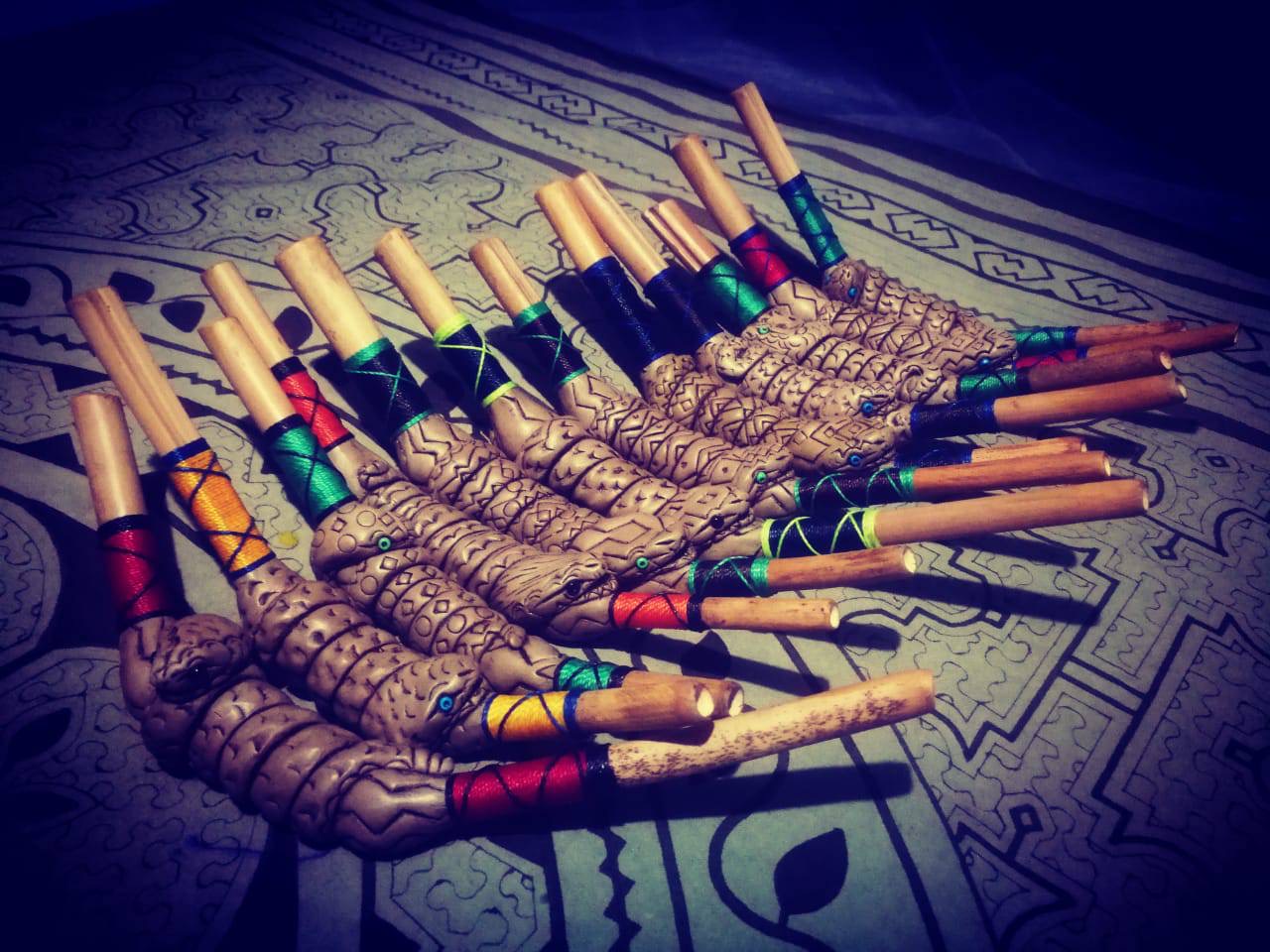
The Tepi is an applicator that is used when somebody wants to blow mediciny to another person, normally a shaman or the person conducting a ceremonial.
The people in the forest use it for cere...
Mapacho: Sacred Tabaco and a Bridge to Spirit
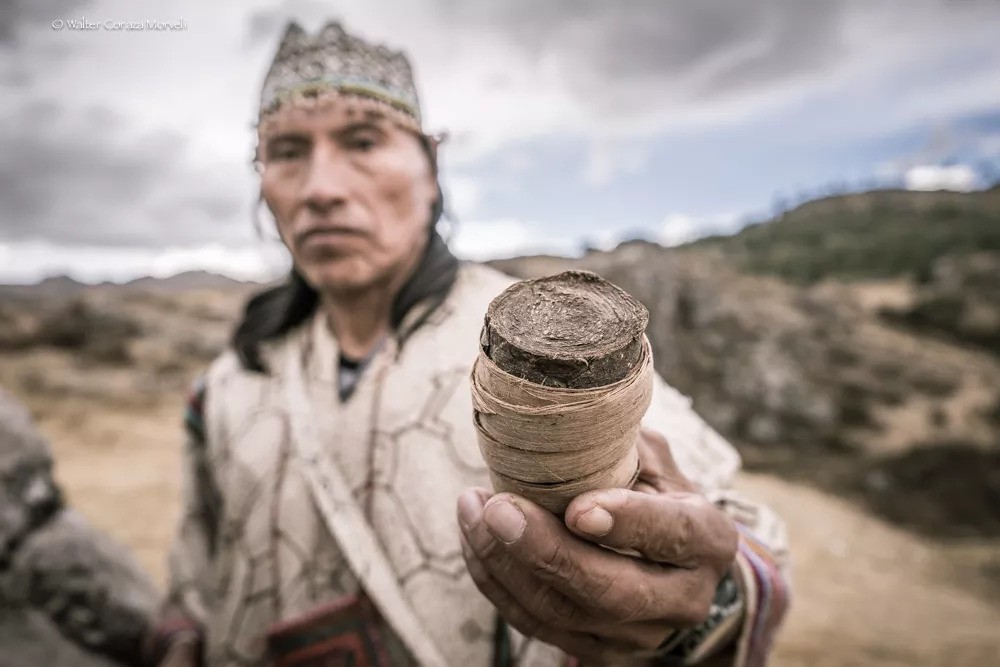
Mapacho, also known as Nicotiana rustica, holds a deeply respected place in Amazonian traditions. Far more potent than the everyday tabaco found in cigarettes, Mapacho has been used for centuries b...